German farms of origin
Medieval farms named Berchof and Berchove in Germany, mostly in the Ruhr area, the possible places of origin of the surname Berkhoff, and what the name means.
1. Introduction
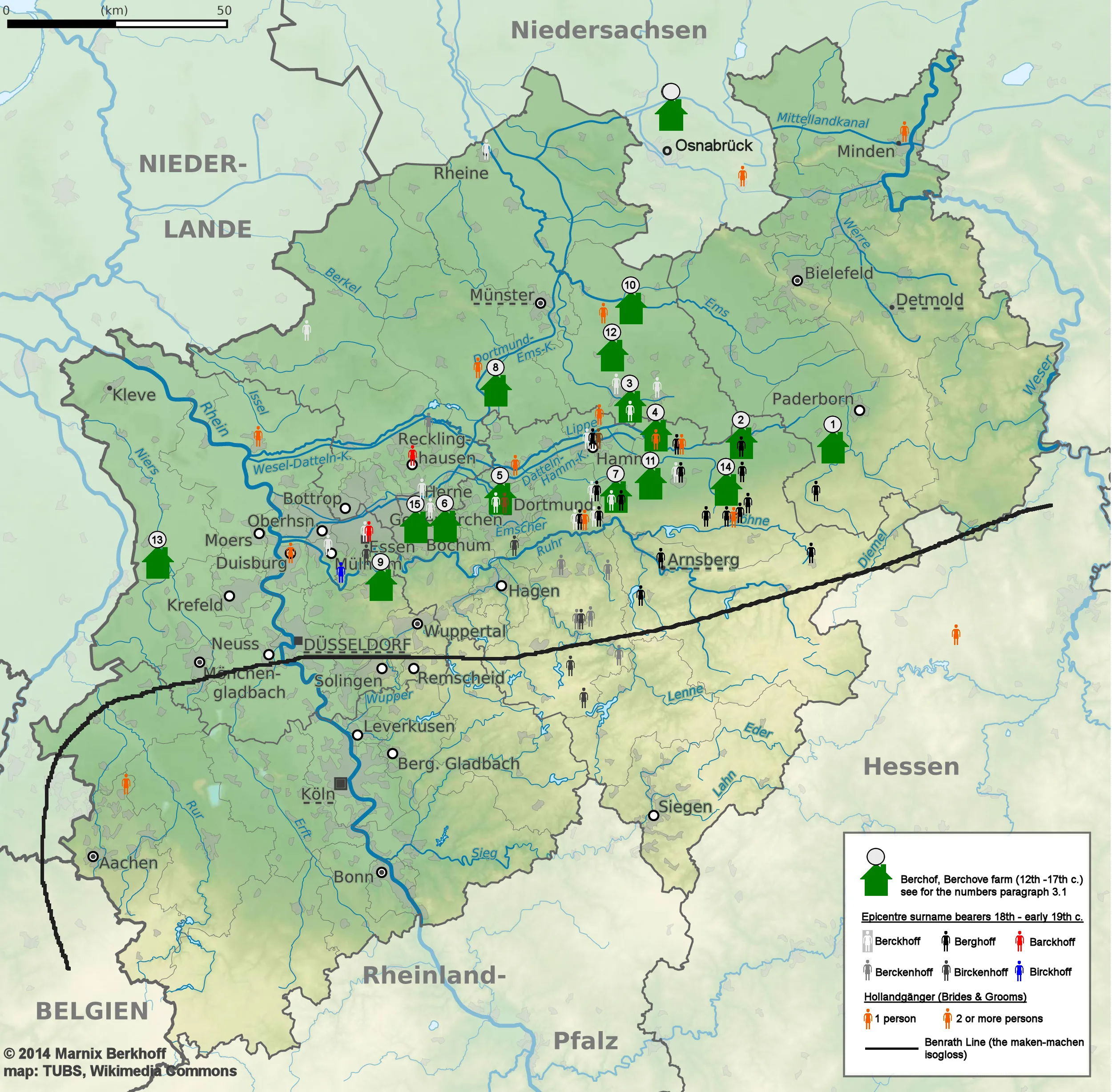
This page is meant for research to the development of the spelling of the surname Berkhoff and for possible places of surname origin in Germany. The surname comes from the medieval farm names Berchof and Berchove. The name is derived from the words berch and hof/hove, meaning hill-farm. The farm name was typical for the Ruhr area and 15 different farms with this name have been found here. The oldest dating back to the 12th century.
Another surname that comes from this medieval farm name is Berghoff. In contradiction to the surname Berkhoff, the name Berghoff can also be found in the mountainous area to the South of the Ruhr. That is, the Sauerland (part of Nordrhein-Westfalen), Rheinland Pfalz and Hessen. Here too several historical name farms must have existed, but for some unknown reason, none of them were found on the internet.
During the 17th and 18th century many Germans went to the Netherlands in the hope of a better life, Hollandgänger. Many settled down and married, some stayed only for a short period of time and returned. Others enlisted the East or West Indian Company and sailed to the Dutch colonies. Their names and places of origin can be found back in Marriage Banns and Muster Rolls. They give an impression about the distribution of the surname in Germany.
For this page the following websites have been used: Books.google.nl, Lwl.org, archief.amsterdam, Vocopvarenden.nationaalarchief.nl, Familysearch.org, G. Köbler, Mittelniederdeutsches Wörterbuch, Mittelhochdeutsches Wörterbuch and Verwandt.de.
2. History of the surname Berkhoff and its dialect forms
2.1 Introduction
The spelling of the surname Berkhoff changed over time. The spelling as we know it today (Berkhoff) came in use in the 18th century. From the 18th back to the 16th century the name was written as Berckhoff and Berckhoven. However, there are traces of the last variant dating back to the 14th century. The surname is in the end derived from the medieval farm names Berchof and Berchove. Traces of these names date from the 17th back to the 12th century and were found in the Ruhr area (15 farms), in Bremen (one) and Osnabrück (one). See for an annotated list below. In some cases the spelling Barchof and Barchove have been found (Dortmund, Bremen and Dolberg). They were used in the same documents synonymously with Berchof and Berckhoven and date back to the 14th and possibly to the 13th century. Not only the spelling of the name changed, the languages used in these areas changed too. To understand the meaning of the name, we first have to take a closer look at the development of these languages.
2.2 Language Developments
All the found Berkhoff farms, are located in an area in Germany where the Low German Dialect is used (see map: Dutch-German Dialects). The Dialect areas shown on the map, Frisian, Dutch, Low- and High German, hardly changed over time. At least, not important for us. So we only have to worry about the succeeding language phases. The oldest known phase of Low German from which written accounts are handed down, is called Old Low German. It was in use from about 500-1100 A.D. and it is considered as closely related to Old Dutch (500-1150 A.D.), Old Frisian (700-1500 A.D.) and Old English (450-1150 A.D.). The differences between Old Low- and Old High German (500-1050 A.D.) are more important. This due to the so-called High German Consonant Shift. This consonant shift took place during the 3rd and 9th century A.D. and altered a number of consonants in (only) the Southern German dialects. One of these is important for our surname history: the maken-machen isogloss, better known as the Benrath Line. This consonant shift took place in the 4th and 5th century A.D. and is considered as the line that divides the Low German (maken) from the High German (machen).
Old Low German was succeeded by Middle Low German. This dialect was in use from about 1100-1600 and is considered as closely related to Middle Dutch (1200-1500) and Old Frisian (700-1500). It served as the international lingua franca of the Hanseatic League. The trading organization stretched from as far as the Baltics in the East to The Netherlands and Flanders in the West. Middle High German replaced Old High German. It was only shortly in use from 1050-1350 and then replaced by Early New High German (1350-1650) and later New High German (1650-present). The decline of the Hanseatic League and the Protestant Reformation in the 16th century, caused The Middle Low German dialect to be succeeded by Low German (1600-present). In The Netherlands, Spanish rule and the Dutch Revolt against it (1568-1648) had accelerated Dutch dialect language developments. It caused Middle Dutch to be succeeded by New Dutch (1500-present). The German Luther Bible (1545) and the Dutch States Bible (1637) sparked off a process towards national languages. This process gained momentum in the second half of 19th and in the early 20th century. Nation building and education almost replaced Low German, High German and New Dutch by Standard German and Standard Dutch as we use them today.
2.3 Meaning of the surname
Back to the spellings we have found; Berchof and Berchove (12th-17th century), Barchof and Barchove (14th-16th century), Berckhof and Berckhoven (16th-18th century). What do these names mean? For about seven different farms an explanation of the name was found in the old documents themselves: a farm (hof/hove) on a hill (berch/barch), or a description that made clear that the farm was located on higher ground. But, are there other explanations possible? For example as: farm with birches? And what happens when we split up the name in berc/barc and hof/hove, in stead of berch/barch and hof/hove? Let’s take a look in Gerhard Köbler, Mittelniederdeutsches Wörterbuch (2014). Because the Benrath Line and with it the High German district, is only 50 kilometres away, it can also be interesting to take a look in Gerhard Köbler’s, Mittelhochdeutsches Wörterbuch (2014).
Historical dictionaries of Low German (1600-present) and High German (1650-present) do not exist.
2.3.1 Word meaning and -compounds in Middle Low German (1100-1600):
Word meaning:
- barc
- barch, barg. Meaning: barn without walls, roof on poles;
- barck
- barcke
- barg, -. Synonym: barch
- barge
- bark,-. Meaning: bark, tree bark to tin, shell of a large pea; synonym: barke
- barke. Köbler gives three explanations: 1). barke, berke. Meaning: sea ship, small transport ship; 2). barke, -. Synonym: berke; 3). barke, bark. Meaning: tree bark to tin, shell of a large pea; synonym: bark
- barken. Köbler gives two explanations: 1). barken, -. Meaning: to tan, to brown; 2). barken, -. Meaning: but
- baringe
- barninge, -. Synonym: berninge
- berc
- bercboum
- berch. Köbler gives three explanations: 1). berche, berg. Meaning: open barn without walls; synonym: barch. 2). berche, berich, berg. Meaning: hill, lowlands, the Alps, a mine, forest, grove, rampart, clenching your fist; 3). berche, -. Meaning: to keep, to protect; synonym: bergen
- berchof
- berchove
- berck
- berg
- berge, -. Meaning: hiding place
- bergen, -. Meaning: to store
- berk
- berke, barke. Meaning: birch
- berkenbōm, -. Meaning: birch tree, birch
- berken, -. Meaning: from birch wood
- berringe
- berninge, barninge. Meaning: fire, fuel, burnt offer
- birc
- birch
- birche
- birck
- birge
- birk
- birken
- borc
- borch. Köbler gives four explanations: 1). borch, -. Meaning: credit, warranting, guarantee, to give something as a borg; 2). borch, -. Meaning: a female garment, vest, jacket; 3). borch, borg. Meaning: castle, house, town, stage scaffolding, stage construction; 4). borch, borg, barch. Meaning: castrated bear
- borck
- borg. Köbler gives two synonyms: 1). borch, borg. Synonym: borch 1; 2). borch, borg. Synonym: borch 3
- borge. Köbler gives three explanations: 1). borge, -. Meaning: guarantor, guarantee; 2). börge, -. Meaning: being used as a guarante; 3). börge, börje. Meaning: stretcher
- borgen. Köbler gives two explanations: 1). borgen, -. Meaning: to borrow, to take debts; 2). borgen, -. Meaning: to vouch, to act as guarantee
- bork
- burc
- burch
- burck
- burg
- burk
- hoef
- hoeve
- hof. Köbler gives three explanations: 1). hof, -. Meaning: often enclosed space next to a building, or around a building. Köbler continues with examples of usages of the word; 2). hof, -. Meaning: hoof (of an animal); 3). hof, -. Meaning: ungulate?
- hove, hoven, hoeve, hoyve, houve, houfe, hufe. Meaning: farmers place or location of a certain size, tenancy, fief, (several) related pieces of cultivated land, city district?
- hoven. Köbler gives two explanations: 1). hoven, hofen. Meaning: to accommodate, to provide sanctuary, to hold high court, holding court to keep, celebrating feast, dancing; 2). hoven, -. Meaning: to require, to need Word Compounds:
- berch: berchgeist, berchhāne, berchhenne, berchhēre, berchknāpe, berchman, berchwater etc. All words compounds with the meaning: hill-.
- berchen:
- berk: bērkanne (beer pull), bērkeare (tanner), bērkāre (beer cart), berkæreambacht (tanner craft), berkdinc (diet), berkdingeslüde (assessor diet), berkdingeswinde (verdict diet), berkgericht (diet court), Several more words with meaning: beer- or diet-. Only two words with the meaning birch: berkstrük (birch bush) and Birkwurz (birch root)
- berke: berken (from birch wood), berkenbōm (birch tree), berkendāver (bark, birch bark), berkenhāne (black grouse), berkenholt (birch wood), berkenmei (birch branch), berkenmeier (wooden drinking utensils), berkenōrt (corners lined with birch), berkenrīs (birch branch)
2.3.2 Meaning and word compounds in Middle High German (1050-1350)
Word meaning:
- barc. Köbler gives two explanations: 1). barc, -. Meaning: male pig, castrated bear; 2). barc, -. Meaning: measurement unit for grain, barn, wooden scaffolding
- barch
- barck
- barcke
- barg
- barge
- bark
- barke, -. Meaning: bark, small boot, boot. sea ship, small transport ship. 2) barke,-. bark, tree bark to tin, shell of a large pea; synonym: bark
- barken, -. Meaning: rowing, going ashore with a (small) boot
- baringe
- barninge
- berc. Köbler gives two explanations: 1). berc, perc. Meaning, hill, vineyard, mine; 2). berc, -. Meaning: enclosure, concealment, hiding, protection, location that is suitable for hiding, rampart;
- bercboum, -. Meaning, hill tree, tree on a hill
- berch
- berchof, -. Meaning: berghof, farm on a hill
- berchove
- berck
- berg
- berge. Synonym: bergen
- bergen. Köbler gives two explanations: 1). bergen, -. Meaning: to protect, to hide, to bring into safety, to conceal, to keep in a secret place; 2). bergen, -. Meaning: hiding, storing
- berk
- berke
- berkenboem
- berken
- berringe
- berninge
- birc
- birch
- birche, -. Meaning: birch
- birck
- birge, -. Meaning: hill
- birke, birche. Meaning: birch
- birken
- borc
- borch
- borck
- borg
- borge. Köbler gives one explanation and a synonym: 1). borge, -. Meaning: protection, postponement; 2). borge, -. Synonym: bürge
- borgen. Köbler gives two explanations and two synonyms: 1): borgen, -. Meaning: to lend, to borrow, to guarantee; 2): borgen, -. Meaning: guarantee, deposit; 3). borgen. Synonym: bergen; 4): borgen. Synonym: verbergen
- borke, -. Meaning: tree bark
- burc Köbler gives three explanation: 1). burc, burec, buric, purc. Meaning: castle, fortified place, town, castle dweller, townsman; 2). burc, -. Meaning: eunuch, servant; 3). bürc, birge. Meaning: mountains
- burch
- burck
- burge. Köbler gives two explanations and one synonym: 1). burge, borge. Meaning: guarantee, hostage; 2) burge, -. Meaning: being the guarantee; 3). burge, -. Synonym: burgen
- burgen, -. Meaning: to guarantee, to vouch, to express
- burk
- hoef
- hoeve
- hof. Köbler gives one synonym and one axplanation: 1). hof, -. Synonym: hove; 2). hof, hob. Meaning: home, residence, business location, administrative location, agricultural property. Köbler continues with examples of usages of the word
- hove, -. Synonym: hof
- hoven Word Compounds:
- berc: bercboum (tree on a hill), bercbrunne, bergegene, bergerihte, bercknappe, etc. All words compounds with the meaning: hill-.
- bercen:
- birk: birkach (forest of birch trees); only one word compound is given.
- birke: birken (berken, from birch wood), birkenholz; only one word compound is given.
2.3.3 Meaning and word compounds in Early New High German (1350-1650)
A New High German dictionary is not online available.
2.3.4 Conclusions
Köblers Mittelniederdeutsches Wörterbuch (2014) confirms the found meaning of farm on a hill, for the Middle Low German dialect area (1100-1600). It also explains the occasional find of the spelling Barchof and Barchove as synonymous. Although the word barch is also used in the meaning of tree bark, it seems less likely that it (also) refers to a birch tree too. This because the word barch has another common meaning of small boot. Another reason is because a birch tree was normally referred to as a berke, sometimes spelled as barke. When the meaning farm with birches was intended, the spelling Berkenhof or Barkenhoven would have been more obvious. This word compound (Berken- and Barken-) is supported by looking at other word compounds with the meaning hill- (berch-) and birch- (berken-). However, the spellings Berkenhof and Barkenhoven have not been found in relation to Berchof and Berchove farms. We have only found the spelling Berckhof and Berckhoven, which came into use in the 16th century. This spelling was used up to the 18th century in connection with the found medieval Berchof and Berchove farms. Apparently the new spelling was considered as an innovation in the Low German dialect (1600-present) for farms with the meaning farm on a hill.
Of early Low- (1600-present) and early High German (1650-present) unfortunately no dictionaries exist. Therefore we do not know how and when the spelling of the Middle Low German words berch and berke developed into the present day Standard German words berg and birke. Nevertheless, according the Benrath Line story (the High German Consonant Shift that changed the pronunciation of the letter -k- into -ch-, such as maken (Low German) into machen (High German)), we may assume that the 16th century development of the spelling Berchof and Berchove into the spelling Berckhof and Berckhoven, is grammatically correct. We may further assume that the arise of name Berghoff in the Ruhr area of the 18th century, reflected language developments of that time, when the Low German dialect was strongly influenced by the High German dialect. This development was somewhere in the process fixated for surnames in 1876 with the introduction of the Standesamt. When we take a look at the distribution of the names in the German phone book (see: Verwandt.de) we see the name Berkhoff distributed in the North, the name Berghoff in the South, with both of them in the Ruhr area; just North of the Benrath Line.
Dictionaries and Literature
Dictionaries:
- Dictionaries can be found best by using Wikipedia. Unfortunately no (online) dictionary exists of early Low- and High German.
Secondary literature:
- Beitrage zur Namenforschung XI (1976), pp. 138. According the index, there seems to be a micro history in the book about the spelling of the surname which confirms the explanation of Berkhoff as mountain-farm and synonymous with Berghoff. Unfortunately, however, Google Books gives because of copyright only a small fragment.
- G. Fenwick Jones, German-American Names (3 ed. 2006), pp. 91. Fenwick Jones also confirms the explanation of Berkhoff as mountain-farm and synonymous with Berghoff. He further claims that the surname Berkoff a French translation is, with the same meaning. Because of copyright, only the index of the book is available in Google Books.
2.4 The 17th century arise of the spellings Berghoff, Barckhoff, Berckhoff, Berckenhoff, Birckhoff and Birckenhoff
Up to the 17th century, the only spelling we found to denote a farm on a hill, was Berchof and Berchove. For the 17th century, Google Books shows us a remarkable phenomenon: the arise of the spellings Berghoff, Barckhoff, Berckhof, Birckhoff, Berckenhoff and Birckenhoff. You can see this happening when you sort in Google Books the research results of one of these names by period. For example Birckhoff for the period 1700-1799. The arise of these different spellings is most likely the result of the succeeding of the Middle Low- (1100-1600) and Early New High German dialect (1350-1650) into the Low- (1600-present) and High German dialect (1650-present). The development of the spelling Berchof and Berchove into Berckhof and Berckhoven has been discussed above in chapter 2.3.4 Conclusions.
Because of the language developments of the 17th century, lesser used Low- and High German synonyms of the medieval farm name made it (apparently) into surnames: Barchof into Barkhoff in the Low German area and Birchof into Birkhoff in especially the Rhenish Fan, a melting pot of Dutch, Low- and High German dialects along the river Rhine, up to the Dutch border (see: Verwandt.de). What does come as a surprise is the appearance of the names Berkenhoff and Birkenhoff. When we take a look at Low- and High German word compounds, the plural form Berken- and Birken- is what we expect when the meaning farm with birches is intended. Unfortunately no dictionaries exist of early Low- (1600-present) and early High German (1650-present). Therefore we do not know how the spelling of the Middle Low German words berch and berke, and of the High German words birche and birke, developed into the (present day) Standard German words berg and birke. The names Berkenhoff and Birkenhoff makes us especially wonder what meaning was intended with these names. Was it farm on a hill, or farm with birches?
2.5 Table of surname epicentre in 18th and early 19th century in Nordrhein-Westfalen
| Surname | 18th and early 19th century surname epicentre in Nordrhein-Westfalen (according Familysearch.org) |
|---|---|
| Barckhoff | Essen, Recklinghausen |
| Berckhoff | Ahlen, Altenbögge, Beckum, Bockum, Borken, Dolberg, Dortmund, Essen, Flierich, Hamm, Herne, Lünern, Mühlheim, Rheine, Soest, Unna |
| Berghoff | Allagen, Altenbögge, Altenbüren, Altenrüthen, Anröchte, Arnsberg, Belecke, Brilon, Effeln, Erwitte, Flierich, Hamm, Lünern, Oestinghausen, Rüthen, Soest, Stockum, Unna, Weiberg |
| Berckenhoff | Altena, Arnsberg, Dahlen, Datteln, Deilinghofen, Evingsen, Iserlohn, Plettenberg |
| Birckhoff | Mühlheim |
| Birckenhoff | Altena, Arnsberg, Hörde, Lüdenscheid, Kettwig, Meinerzhagen |
3. Farms and homesteads in Nordrhein-Westfalen and in the rest of Germany
In Germany and especially Nordrhein-Westfalen, several Berkhoff farms or homesteads can be found. Below a list of farms found by using Google Books and the Urkunden-Datenbank of Lwl.org. The list is not complete. Please let me know through the contact form if you have found traces of farms from before 1860 that are not on this list. The oldest traces of farms can be found with the spelling Berchof, Berchove, Berckhoff and Berckhoven and date from the 12th century. Remarkable is that no berchof or berchove farms were found South in the Sauerland (part of Nordrhein-Westfalen), Rheinland-Pfalz and Hessen. Although this area is part of the High German dialect district (the Ruhr is part of the Low German dialect district), the words Berchof and Berchove were used here too with the same meaning of berchove. The lack of finds in the High German dialect district is possibly because no old documents and books are available in Google from this area. See for an amount of hamlets with this name here Wikipedia: Berghof.
3.1 Farms and homesteads in Nordrhein-Westfalen
3.1.1 Wewelsburg-Ahden, near Paderborn
In a regest from June 6 1345 a “Kurie” Berchof is mentioned. A kurie is an estate belonging to the pope. The farm is supervised by the Kapittel of the Busdorf Church from Paderborn. The regest is archived in the Erzbischöfliche Akademische Bibliothek Paderborn. In a regest of April 4 1363 possibly the same farm is mentioned. It speaks about a Berchoff near Adene, owned by a burger from Paderborn. Most likely this is the small village Ahden, fifteen kilometres Southwest of Paderborn. The regest can be found in the archive of Erpernburg. Then there is a regest from an unknown date from 1433. In it a Berchove is mentioned near “Wevelsborgh”. Wewelsburg is a small village next to the village of Ahden. In the regest the farm is sold by Friedrich v. Graffen to Olrik und Volmar v. Brenken. This regest is also archived in Erpernburg. When you look at Google maps, you can find a streetname Berghof in Wewelsburg. Was the farm located there ?
3.1.2 Anröchte
In a regest of December 4 1490 a Berckhof near Robberynchusen is mentioned. In it Helmich von Erwitte transfers the farm to Abbot Petronille von Galen. The regest is archived by the Monastery of Benninghausen. Today, Robberynchusen is the hamlet Robringhausen near Anröchte. The same farm is mentioned in a regest of May 25 1497 (a Berchoff near Robberynchusen). This regest is also stored by the Monastery of Benninghausen.
3.1.3 Dolberg
In a regest of February 1 1514 for the first time an “Erbe Berchoff” is mentioned in the parish and “Bauerschaft” Dolberge. Possibly owned by Dietrich Harmen. Several other regests mention a farm in this place. In a regest of 1524 a more specific location is mentioned: the Berchoff near “Gemmerk” in the parish Doilberge under the jurisdiction of Ahlen. In a regest of 1530 a fishpond is mentioned in connection to the farm. According a regest of 1578, the farm belonged to the Bauerschaft Westdolberg, but according a regest of 1583 the farm belong to the Bauerschaft Oistdulberge. After a gap of a century long, a last regest of 1698 gives a trace that the farm still existed. Other regests can be found for the years 1518, 1567 and 1573 and they all can be found in the archive of Uentrop. According the regest of 1518 the name Berchoff and Berghove(n) were sometimes used side by side for the same farm. Most likely the farm is still there; there is a forest just North of Dolberg named Gross Berkhoff. The addition Gross suggests that there is also a Klein Berkhoff. Was it in Dolberg? Or somewhere else?
3.1.4 Uentrop
In a regest of February 25 1400 Johann Morrien der Alte verkauft half of the Berchof to Johann Haermann. Nothing about a location can be found. The regest is stored in Uentrop. A regest of 1609 speaks about a Hof Berckhoff in the County of Mark, parish Untorff, owned by the church of Untorff. The regest is archived in the archive of Uentrop. Two centuries later this farm most likely still existed, because in 1829 the exact location of a Berckhoff farm in (the South of) Uentrop was written down in the land register of that year, the Urkatasterkarte der Steuergemeinde Uentrop. You can wonder if the farm mentioned in the regest of 1400, is the same farm as the farm of the regest of 1609.
3.1.5 Berghofen in Dortmund
Berghofen is first mentioned in 1220 in the Vogteirolle from Friedrich von Altena-Isenberg. In 1229 it was the home of Theodericus de Berchoven, a noble man who used the name of place as a surname. In the 14th century the estate became a fief of the Count of Mark. In 1350 the Count of Mark made Henryke van Barchove hereditary sheriff. The text can be found in: J.D. von Steinen, Versuch einer Westphälischen Geschichte besonders der Graffschatt Mark V (1757), pp. 635. In 1389 the estate was demolished during the strife between the Count of Mark and the Reichstadt Dortmund. In 1425 it burnt down again in another strife, now between the Count of Mark and the Duke von Berg. According a list of 1486 the estate comprised 15 farms. In 1609 together with the County of Mark, it became part of Brandenburg-Preusen. In 1777 a total of 197 inhabitants were listed. And in 1800 it comprised 500 morgen land. The noble Berchoven family died out somewhere in the 15th century. Some genealogy and heraldry can be found in: J.D. von Steinen, Westphälische Geschichte II (1755), pp. 682-4. The Haus Berghofen was rebuilt in 1684 and demolished in 1969. Today it is a district of Dortmund of about 500 hectares. See Wikipedia: Dortmund-Berghofen.
3.1.6 Harpen, near Bochum
Another old farm Berchofen or Berckhoven is mentioned in Niklas (or Nicolaus) Kindlinger, Munsterische Beitrage zur Geschichte Deutschlandes Dritten Bandes (1793), pp 554-9. According a cited regest of 1404 the farm was in the parish Harpen, in the jurisdiction Boechum. The regest is about selling the farm by the noble woman Margaretha van der Marke to Ritter Pylgrime van der Leyten. The book can be found in Google books. Possibly the farm was part of the Berghofen estate in Dortmund, because of the name of the owner in 1404, noble Margereta van der Mark. See above 3.4 Dortmund. The farm already existed in 1276, U. Vahrenhold-Huland, Grundlagen und Entstehung des Territoriums der Grafschaft Mark (1968), pp. 201. Vahrenhold lists it under Berghofen.
3.1.7 Flierich
According to H. Conrad, in his article “Kommunalarchive des Kreises Siegen und des Hochsauerland-Kreises, Privatarchive in Rheda und Hamm”, in: Archivpflege in Westfalen und Lippe XIV (1980), pp. 13-15, there 15, there was a Berckhoff in Flierich. No years or exact location are mentioned.
3.1.8 Brochtrup, near Lüdinghausen
A regest of February 19 1570 mentions a Berchofen in Brochtrup in the parish Lüdinkhausen. The farm is owned by Lubbert von Heiden to Hagenbeck and is farmed out. The regest is archived in the Archive of Landsberg-Velen.
3.1.9 Heisingen, near Essen
The streets the Barkhovenallee and the Barkhovenhöhe in the district Heisingen in Essen, is what is left of an old, large farm. In 1370 it is mentioned as a major farm in a list of 23 farms owned by the Abbey of Werden. But most likely the farm was much older, and possibly it dated back to the 10th century. In A. Schuncken Geschichte der Reichsabtei Werden an der Ruhr (1865), pp. 220-3, there is a list of 1767 with farm rights (Hofsrechten). In it the farm was also mentioned as Berckhoven. In 1802, because of secularization, the farms became property of Preusen. See Wikipedia: Heisingen.
3.1.10 Freckenhorst, Warendorf
In E. Friedländer, Die Heberegister des Klosters Freckenhorst nebst Stiftungsurkunde, Pfründeordnung und Hofrecht (1872), pp. 97, a Barechove or Berchove is mentioned. No location or date is given, but the context gives the impression suggests the beginning of the 13th century. According to K. Gruhn in his book Freckenhorst in alten Ansichten (c. 2010) the farm was replaced by the Vikarie Maria Magdalena. Today on that place there is a Kindergarten. Searching some further gives a location: Stiftsbleiche 2. In W. de Gruyter, Das Bistum Münster III (1975), pp. 143-4, more can be found of this Vikarie and the farm. In 1333 the Vikarie obtained the Rittersitz Barkhove. The farm was then demolished and replaced by the Vikarie.
3.1.11 Flerke, Soest
According to U. Vahrenhold-Huland in: Grundlagen und Entstehung des Territoriums der Grafschaft Mark (1968), pp. 201, there was a Berchove or Berghhoyve in Flerke near Soest in 1392/3. Unfortunately, Google Books gives because of copyright only a small fragment. Possibly the same farm is mentioned as Berchoff, -hof, -hove, Berichowe (Berghof) in the index of: Das älteste Bürgerbuch der Stadt Soest 1302-1449 (1958), pp. 258. Again, Because of Google books, only a fragment.
3.1.12 Sendenhorst
According a regest in Conradus von Vornholte and Swederus Rupe sell on March 20 1336 the Berchove to the Kloster Vinnenberg in Kreis Warendorf. The regest is archived in the archive of Kloster Vinneberg. According a Register of the Kloster Vinnenberg of 1465-1534, the farm Berchove was still in its possession in 1503.
3.1.13 Wachtendonk
In Das Hauptstaatsarchiv Düsseldorf und seine Bestände V (1972), pp. 61, a Hof Berchoff is mentioned in Wachtendonk for the years 1624-9. Because of Google books, only a fragment.
3.1.14 Warstein
In Die Regesten der Erzbischöfe von Köln im Mittelalter VIII (1981), pp. 102, a Hoff named Berchoff by Warstein is mentioned, with a date: December 12 1371. Because of Google books, only a fragment.
3.1.15 Wattenscheid, Bochum
In 1439 Rötger Dücker obtained a Berckhoven in Wattenscheid near Bochum as a fief from the Abbot of Werden. A. Fahne, Die Herren und Freiherren v. Hövel, nebst Genealogie der Familien, aus denen sie ihre Frauen genommen I (1860), pp. 57.
3.2 Farms and homesteads in the rest of Germany
3.2.1 Berkhof in Wedemark, near Hannover
North of Hannover, there is a hamlet named Berkhof. It is part of Wedemark. Its history goes back to 1381 when it was named Birkenhof. See Wikipedia: Berkhof.
3.2.2 Barkhof in Schwachhausen, Bremen,
The history of the District Barkhof in Bremen goes back to the Bremer Weidebrief of 1159. The document mentions a archiepiscopal farm with the name Berchowe. It was a large farm. In a regest of 1313 it is named Berchhof, in 1342 Berchof, in 1365 Berkhove and in 1412 Berckhof. According H.W. Haefs in Anmerkungen Zur Geschichte Von Stadt und Land Bremen. Anhand der Orts- und Siedlungsnamen (2006), pp. 33, the name is derived from the words Berg and Hof, this is translated farm on the hill. See Wikipedia: Barkhof.
3.2.3 Berghof in Bramsche, near Osnabrück
According the Mittheilungen des Historischen Vereins zu Osnabrück III (1853), pp 186, there was a Berchove in “K. zu Bramsche und B. Pente - in D. st.” Today you can find there a Naturfreunden Haus at the Osnabrücker Strasse 60 in Pente near Bramsche a Naturfreundenhaus Berghof. The name was taken from the previous farm there. The last owner was named Hinrich Berchof.
4. Hollandgänger
During the 17th and 18th century, many Germans went to The Netherlands in the hope of a better life. As the motor of the Dutch Republic, Amsterdam attracted most of them. Some stayed only for a short time, doing seasonal work and returned home. Others married and stayed. Some enlisted the West or East Indian Company and sailed to the Dutch colonies. Their names and places of origin can be found back in Marriage Banns and Muster Rolls. Up to halfway the 17th century the patronymic naming system (for example Barent Barents[on]) was custom. Because of the increasing population, the use of surnames became in the second half of the 17th century fashionable as an addition. Especially in the cities. Sometimes they even replaced the patronymic. In the large variety of surnames, farm names were used as surname too. It is therefore that from the end of the 17th century onwards Hollandgänger who originate somehow from a Berchof farm, can be traced back, by their surname, to their place of origin.
Looking at these lists in the next paragraphs it is important to realise that in the old days there was no fixed spelling (of surnames). Names were written down as (Dutch) officials heard it pronounced by Hollandgänger themselves. So, being able to write ones own name, proved to be decisive in the handing down of the spelling to future generations. Even though there was no fixed spelling, there was a favourite, or default spelling. In The Netherlands the spelling Berkhoff served as thus. That explains why some Hollandgänger from the Sauerland, Rheinland-Pfalz and Hessen were listed as Berkhoff. But, as you will see, the vast majority came from the Ruhr area.
4.1 List of Bride and Grooms
As the motor of the Dutch Republic, Amsterdam attracted many fortune-hunters. They can be found by using archief.amsterdam. Places of origin however can not be found on the website. For this I have consulted the micro-fiches. Note that in the Netherlands of the 18th century, especially in the West, surnames were commonplace, so Hollandgänger were almost expected to have one. Note also that the places of origin written down in the Marriage Banns functioned as a kind of ancient nationality. Emigrants could not just make up a surname and a place of origin. They brought with them a letter from the pastor of their parish of origin, as a kind of identification. The places of origin, however, were sometimes written down in a different spelling than we use today. The old spelling can be found between (). In ‘ancient Germany’ there was no freedom of religion. This means that the Hollandgänger found in The Netherlands had the religion of their concerning Diocese or Duchy. But you have to keep in mind that Hollandgänger could have gone to the Netherlands because they wanted to profess another religion than was allowed in their German hometown.
| Found in | From | Name | Year | Religion | Family Branch |
|---|---|---|---|---|---|
| Amsterdam | ? (Auenhelfell) | Hendrikes Berghof | * ca. 1760 | Catholic | |
| Amsterdam | Beckinghausen (Bekkinghuizen) | Elizabeth Berkhoff | * ca. 1705 | Catholic | |
| Amsterdam | Blankenstein (idem) | Godfried Berkhoff | * ca. 1761 | Evangelical Lutheran | |
| Amsterdam | Bremen (idem) | Beletje Berkhoven | * ca. 1677 | ? | |
| Amsterdam | Dortmund (idem) | Margreta Berkhoff | * ca. 1700 | ? | |
| Amsterdam | Dülmen (idem) | Barent Berkhoff | * ca. 1652 | ? | |
| Amsterdam | Hamm (Den Ham) | Caspar Berkhoff | * ca. 1695 | Dutch Reformed | |
| Amsterdam | Hamm (Den Ham) | Harmanus Berkhoff | * ca. 1776 | Dutch Reformed | Amsterdam 2 |
| Amsterdam | Hamm (Den Ham) | Hendrik Berkhoff | * ca. 1680 | Dutch Reformed | Amsterdam 2 |
| Amsterdam | Hamm (Den Ham) | Jan Berkhoven | * ca. 1777 | Dutch Reformed | Amsterdam 3 |
| Amsterdam | Hamm (Den Ham) | Engel Maria Berkhoff | * ca. 1712 | ? | |
| Amsterdam | Hamm (Den Ham) | Grietje van Berkhoven | * ca. 1679 | ? | |
| Amsterdam | Hamm (Den Ham) | Hendrik Berkhoff | * ca. 1669 | ? | |
| Amsterdam | Hamm (Den Ham) | Hendrik Berkhoff | * ca. 1675 | ? | |
| Amsterdam | Hamm (Den Ham) | Matthijs Berkhoven | * ca. 1669 | ? | |
| Amsterdam | Hamm-Heessen (Heze) | Jan Berkhoff | * ca. 1727 | Catholic | |
| Amsterdam | Höringhausen (Heuringhuizen) | Johannes Berghöfer | * ca. 1757 | Dutch Reformed | |
| Amsterdam | Jülich (Juelle) | Barbara Berghof | * ca. 1712 | ? | |
| Amsterdam | ? (Lits) | Hendrik Berkhoven | * ca. 1695 | ? | |
| Amsterdam | ? (Lis) | Frans Berkhoven | * ca. 1715 | Dutch Reformed | |
| Amsterdam | Minden (Minden) | Margriet Berkhoven | * ca. 1669 | ? | |
| Amsterdam | Oestinghausen (Enstinghausen) | Dirk Berghof | * ca. 1712 | Catholic | |
| Amsterdam | Oldenburg (idem) | Jan Berkhoff | * ca. 1696 | ? | |
| Amsterdam | Uelde (Ulden) | Dirk Berghof | * ca. 1670 | ? | |
| Amsterdam | Uentrop (Untrop) | Jan Dirk Berkhoff | * ca. 1747 | Dutch Reformed | |
| Amsterdam | Unna (Onna) | Barent Berchoef | * ca. 1647 | Dutch Reformed | Amsterdam 1 |
| Amsterdam | ? Warendorf or Thier? (Tierstadt) | Evert Berghof | * ca. 1709 | ? | |
| Amsterdam | Wesel (Wessel) | Willem Berkhoff | * ca. 1712 | Catholic | |
| Den Haag | Dortmund | Dirk Berkhoff | * ca. 1615 | ? | Den Haag |
| Groningen | Leer (Lier, Ost Friesland) | Jodocus Hermannus Berchof | oo 1754 | Catholic | |
| Groningen | Leer (Lehr) | Joseph Berckhof | oo 1785 | ? | |
| Groningen | Everswinkel | Fredrik Berkhof | oo 1754 | ? | |
| Kampen | Melle | Egbert Caspers Barckhooff | * ca. 1630 | ? | Kampen |
| Veenendaal | Duisburg | Goossen Boekhoff | * ca. 1690 | ? | Veenendaal |
| Weesp | Diocese of Münster (Münsterlant) | Christoffel Barents Berckhoff | * ca. 1666 | Catholic | Weesp |
4.2 List of Dutch West India Company (WIC) crew
Several Hollandgänger enlisted the Dutch West India Company. The crewlist is not digitalised yet; only one name is known -so far. The West Indies (New York, Brasil, Surinam) were not popular because the profits of the colonies were poor. Many died on board or in the colonies. Enlisting was for adventurers and poor people without prospects. Note that in the Netherlands of the 18th century, especially in the urban West of the country, surnames were commonplace. So Hollandgänger were (almost) expected to have one. Identification by enlisting was less strict than for marrying (see above), but most of the time people had no reason to make up something. It could get them in trouble later on.
| WIC | From | Name | Departure | Religion | Family Branch |
|---|---|---|---|---|---|
| WIC | Cologne | Adam Brouwer (used later in New York the name: Berckhoven) | ca. 1642 | Dutch Reformed | Brouwer (United States) |
4.3 List of Dutch East India Company (VOC) crew
A lot of Hollandgänger enlisted the Dutch East India Company. The list is made by using Vocopvarenden.nationaalarchief.nl. Enlisting was for adventurers and poor people without prospects. Many died on board. Other lived for some years in the former colonies in South Africa and Indonesia (and died there). Sometimes more documents of the person can be found back in the archives. Of interest here is only the place of origin. Variants of dialect forms of the name such as Barkhof, Birkhof and Berghof were (almost) not found. Probably the officials were not so critical. Note that in the Netherlands of the 18th century, especially in the urban West of the country, surnames were commonplace. So Hollandgänger were (almost) expected to have one. Identification by enlisting was less strict than for marrying (see above), but most of the time people had no reason to make up something. It could get them in trouble later on.
| VOC | From | Name | Departure | Religion | Family Branch |
|---|---|---|---|---|---|
| VOC | Adersleber | Christoffel Berkhoff | 1767 | ||
| VOC | Altona | Asmus Berkhoff | 1747 | ||
| VOC | Arensberg | Johannes Berkhoff | 1755 | ||
| VOC | Arendsberg | Johannes Berkhoff | 1751 | ||
| VOC | Bern Canton | Thomas Berkhoff | 1749 | ||
| VOC | Bremen | Dirk Berghove | 1767 | ||
| VOC | Dalberg | Gerrit Berkhoff | 1768 | ||
| VOC | Durbag | Gerrit Berkhoff | 1750 | ||
| VOC | Erst, Ceurland | Hendrik Berkhoff | 1724 | ||
| VOC | Ersz | Hendrik Berkhoff | 1730 | ||
| VOC | Essemerk | Nicolaas Berkhoff | 1788 | ||
| VOC | Essemark | Nicolai Berghoff | 1788 | ||
| VOC | Hamburgh | Harmen Berkhoff | 1716 | ||
| VOC | Kirkheijm | Hendrik Berkhoff | 1767 | ||
| VOC | Linge | Anthonij Berkhoff | 1773 | ||
| VOC | Millé | Adolf Berckhoff | 1694 | ||
| VOC | Munsterland | Jan Berkhoff | 1738 | ||
| VOC | Munsterland | Jan Berkhof | 1739 | ||
| VOC | Oldenburgh | Frans Berkhoff | 1721 | ||
| VOC | Opherden | Joannes Berkhoff | 1725 | ||
| VOC | Soest | Hans Berkhof | 1723 | ||
| VOC | Soest | Hendr. Berghof | 1715 | ||
| VOC | Straetsburgh | Andries Berkhoffer | 1707 | ||
| VOC | Weeren | Willem Berkhoff | 1739 | ||
| VOC | Wenden aan de Roer | Hermanus Berkhof | 1762 | ||
| VOC | Woostein | Casper Berkhoff | 1729 |
Last updated on 3 November 2026. Text: Marnix Berkhoff (2015).