Dutch farms of origin
Farms and yards in the Netherlands and Belgium named Berchof, Berckhof or Berckhoven, the possible places of origin of the surname Berkhof(f), and what the name means.
1. Introduction
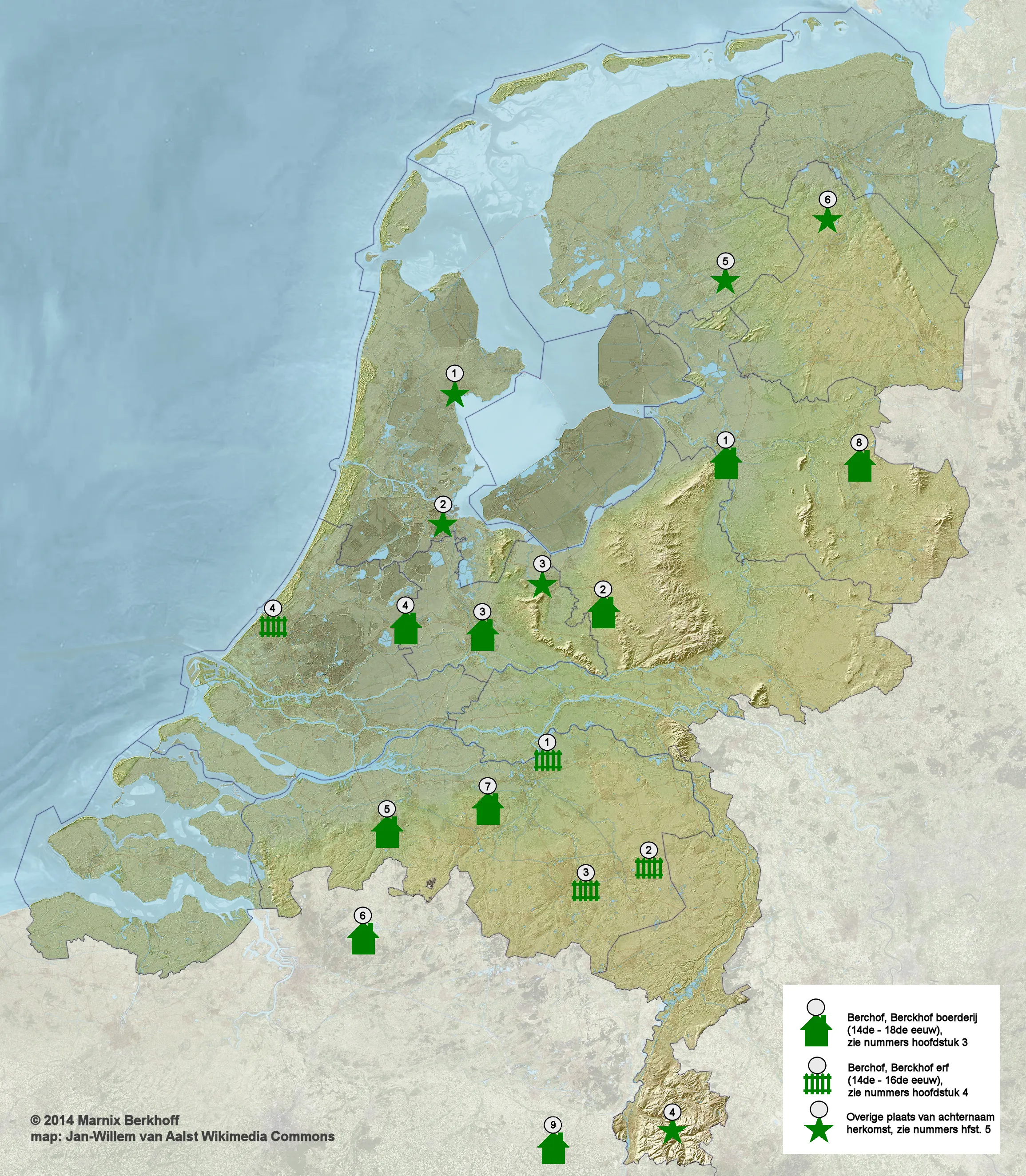
This page is meant for research into the origin of the surname Berkhof(f) and into possible places of origin in the Netherlands. The surname descends from the medieval farm names Berchof and Berchove. The name is derived from the words berch and hof/hoven, meaning a farm or yard on a hill. Another possible meaning, such as a farm with birch trees in the yard, has not been found in old documents. For grammatical reasons this meaning is also less likely. So far nine farms and four yards with the name have been found in the central, eastern and southern Netherlands. The oldest find dates back to the end of the 13th century.
In the Netherlands the surname Berkhof(f) can also have an origin other than a farm name, namely from German immigrants who tried their luck in the Netherlands in the 17th and 18th centuries. For the origin of the German surname see: German Farms of Origin. The so-called dialect forms of the surname, such as Barkhof and Birkhoff, arose from old place names with a different meaning. The surname Berghoff suggests a development along the German pattern.
For this page the research results of the Dutch family trees on this website were used, as well as Books.google.nl, Web Google.nl, the Nederlandse Familienamenbank (Dutch Surname Database) at Meertens.knaw.nl, J. Verdam, Middelnederlands handwoordenboek (1932; repr. 1981), the Nieuwnederlandse Woordenboek at Gtb.inl.nl and G. Köbler, Mittelniederdeutsches Wörterbuch (2014).
2. History of the surname Berkhof(f) and dialect forms
2.1 Introduction
The spelling of the surname Berkhof(f) developed over time. The spelling as we know it today (Berkhof(f)) came into use at the beginning of the 17th century. From the 17th back to the 16th century the surname was written as Berckhof, Berckhoven and, once, Berckhoeve. The surname is derived from the medieval farm names Berchof and Berchove. Traces of these farm names go back from the 16th to the end of the 13th century and have been found in Vriezenveen, Utrecht, Waarder, Udenhout and Piringen (Belgium). See below for an annotated list of all the farms found. Sometimes different spellings are found side by side in the same document for the same farm, such as Berchof and Berckhof. Occasionally the spellings Barchof, Barckhof and Borchof were also found. The final -f- is likewise sometimes single and sometimes double. Not only the spelling of the surname changed, but also the language itself. To understand the meaning of the surname, we must therefore first know a little more about the development of the languages used in the Netherlands in the past.
2.2 Language developments
The Berkhof farms and yards that have been found in the Netherlands are spread over two language areas: the Dutch dialect and the Low German dialect (see map: Dutch-German Dialects). The dialect areas on the map, Frisian, Dutch, Low German and High German, have changed little over time, at least not in ways that matter to us. So we can concentrate on the successive phases of the individual dialects. The oldest known phase of Dutch from which written texts have survived is called Old Dutch. It was used from 500-1150 A.D. and is considered closely related to Old Low German (500-1100 A.D.), Old Frisian (700-1500 A.D.) and even Old English (450-1150 A.D.). The differences between Old Low German and Old High German (500-1050 A.D.) do not at first sight seem important for the Netherlands. Yet between the 3rd and the 9th century developments took place there that affect the history of surnames. These developments are called the Second Germanic Consonant Shift and resulted in several changes in pronunciation in the High German dialect area. One of them is the maken-machen isogloss, better known as the Benrath Line. This sound change took place in the 4th and 5th century A.D. and is considered the boundary between the Low German (maken) and the High German dialect (machen).
Old Dutch was succeeded by Middle Dutch. This was used between 1200 and 1500 and is considered closely related to Middle Low German (1100-1600) and Old Frisian (700-1500). In the Middle Ages Middle Low German held a special position: it was used as the international lingua franca of the Hanseatic League. This trading organisation stretched from the Baltic States in the east to the Netherlands and Flanders in the west. The decline of the Hanseatic League and the Protestant Reformation in the 16th century in southern Germany meant that Middle Low German was succeeded by Low German (1600-present). In the Netherlands language developments were accelerated by Spanish rule and the Revolt against it (1568-1648). Here Middle Dutch was succeeded by the present-day New Dutch (1500-present). The Luther Bible (1545) and the States Bible (Statenvertaling, 1637) set in motion a process towards the formation of national languages. This process gained momentum in the second half of the 19th and the beginning of the 20th century. Through nation building and compulsory education, New Dutch and Low German were almost entirely replaced by Standard Dutch and Standard German, as we use them today.
2.3 Meaning of the surname
Back to the spellings found: Berchof and Berchove (13th-16th century), Barchof and Borchof (16th-17th century), Berckhof and Berckhoven (16th-17th century). What do these names mean? Only once have we found a real explanation. In the documents that speak of a Barchof and a Berchof in The Hague, the description is: a place where haystacks and barns stood. There are also two indications of a meaning. In the documents about two farms at Wiltenburg, a former castle near Utrecht, we find the spellings: Borghove and Berckhoff (1529), die borchove and die borchoff (1531), and die groote berckhoeve and die kleyne berckhoeve (1563). The hypothesis that berck in this case means burg or berg (hill) is not implausible. After all, a burg is a fortification situated somewhat higher up, on a hill.
The hill explanation of the surname is supported by the name of the hamlet Berghof in Gulpen. It is the presumed place of origin of the Maastricht branch of the family. In this family tree both the names Berghof and Berkhof occur. No old documents with spellings of the hamlet have been found. Yet the occurrence of both spellings in this family tree strongly suggests the German pattern of name development, where the names Berghoff and Berkhoff are used as synonyms of each other; both in the sense of a farm on a hill. See: German Farms of Origin (English only).
Debrabander, in his Woordenboek van de familienamen in België en Noord-Frankrijk (2003), gives a completely different meaning, namely: Berkenhof, a farm with birches. He also mentions the hamlet name Berckhoven in Westmalle, Belgium. Winkler too, in his book published a hundred years earlier, De Nederlandse geslachtsnamen in oorsprong, geschiedenis en betekenis (1900), gives the meaning: Berckenhof, a farm of birches. However, the meaning of a farm with birches has not been found in (the) old documents (found). Moreover, according to the Nederlandse Familienamenbank of the Meertens Instituut, the surname Berckenhoff mentioned by Winkler turns out to be very rare to extinct. The 1947 census shows only 3 hits; for 2007 none at all. The surname (Van den) Berkhof, by contrast, occurred (48+)691 times in 1947, the name Berkhoff 267 times. The question is therefore whether the meaning of the name Berckenhoff is representative of the names Berkhof(f). At first sight, of course it is.
Let us see which meanings we can find for the spellings found, for the Dutch and the Low German dialect in the period 1200-present. For this we use J. Verdam, Middelnederlands handwoordenboek (1932; repr. 1981), the New Dutch dictionary on the website of the Instituut voor Nederlandse Lexicologie (Gtb.inl.nl) and G. Köbler, Mittelniederdeutsches Wörterbuch (2014) on the website Koeblergerhard.de. A dictionary of early Low German unfortunately does not exist. First we examine the meaning of individual words. We do this extensively, with all kinds of possible word variants. Then we look at the way in which compounds were formed. In this way we discover how the individual words were used in compounds, whether in the singular or in the plural. In 2.3.5 Conclusions we then look at what all the findings mean for the meaning of the surname.
For a remark on the choice of Verdam’s Middle Dutch dictionary rather than the digital dictionary on the website of the Instituut voor Nederlandse Lexicologie, see the bibliographical note under 2.3.5 Conclusions. There you will also find some remarks on remarkable finds in the Old Dutch (500-1150), Early Middle Dutch (1200-1300) and Middle Dutch (1200-1550) digital dictionaries.
2.3.1 Word meanings and compounds in Middle Dutch (1200-1500)
Word meanings:
- barc, -. Meaning: tree bark
- barch. Verdam gives two explanations: 1). barch. See: berch; 2). barch, barech. Meaning: suckling pig, castrated boar
- barck -
- barcke -
- barg -
- barge, bargie. See: baerdse (meaning: a kind of warship with oars)
- bark -
- barke, baerke, berke. Meaning: light vessel, small boat, boat-shaped seed tray in bird cages
- barken -
- baringe. See: berninge
- barninge. See: berninge
- berc, -. Meaning: tree bark. See: barc
- bercboem -
- berch. Verdam gives three explanations: 1). berch, berech, barech, barch; Meaning: a). hill; b). mountains, mountain range; c). base of the finger; d). burg; 2). berch, barch; Meaning: haystack, grain stack; 3). berch, barch, borch; Meaning: male pig
- berchof -
- berchove -
- berck -
- berg -
- berge -
- bergen. Verdam gives two explanations: 1). bergen, -. Meaning: on high; in this meaning always in the expression: bergen en dalen. 2). bergen, -. Meaning: a). to store away, to hide; b). to bring to safety
- berk -
- berke. Verdam gives two explanations: 1). berke, -. birch tree. 2). berke, -. See: barke
- berkenboem, -. Meaning: birch
- berken -
- berninge, barninge, borninge. Meaning: a). burning or burning up, inflicting a burn, also in medicine [bernen, berren] b). fuel [berninchout]
- berringe, barr-, borr-. Meaning: a) burning, burning up; b) that which burns or is burnt. Cf. berninge
- birc -
- birch -
- birche -
- birck -
- birge -
- birk -
- birken -
- borc -
- borch. Verdam gives two meanings: 1). borch, borech, boorch, burch. Meaning: a). market town, town; b). castle; 2). borch, -. See: berch (hill)
- borck -
- borg -
- borge, boorge, borch. Meaning: a). surety, tot borg heben; b). pledge; c). purchase on credit
- borgen, -. Meaning: a). to protect; b). to stand surety for something; c). to be held to account as surety for something, to pay for something; d). to advance; e). to buy on credit; f). to advance money
- bork -
- burc -
- burch. See: Borch
- burck -
- burg -
- burk -
- hoef -
- hoeve, hove, hoef. Meaning: a piece of land of a certain size, hoeve, hofstede, the land belonging to a farm
- hof. Verdam gives two explanations: 1). hof, -. See: of (meaning: court); 2). hof, -. Meaning: a). enclosed space, place; b). farmhouse, farm, hofstede; c). dwelling of a nobleman, manor house, castle, pleasure palace, residence of the prince, court, palace; d). court, garden; e). court feast, court day; f). solemn court session at which the prince or his representative administered justice; g). ring around the moon.
- hove -
- hoven, haven. Meaning: a). to hold court, to feast, to lead a merry life, to spend freely; b). to sit down at a feast, to dine, also to eat; c). to live, to reside; d). to belong to a certain court, to come under it; e). to assign someone a place of residence, to provide him with shelter or a refuge Compounds:
- berch: berchgras, berchhuus, berchlant, berchloon, berchnagel, bergroede, berchstede, berchsteen
- berchen:
- berk:
- berke: berken (adj.; of birch wood), berkenboem
2.3.2 Word meanings and compounds in New Dutch (1500-present)
Word meanings: Because the spelling found after 1600 is fairly constant (Berckhof and Berckhoven), we limit our research for the period of New Dutch (1500-present) to the meanings berg (hill) and berk(-enboom) (birch). With the help of the digital dictionary on the website of the Instituut voor Nederlandse Lexicologie, we look up which words were used for these meanings at the time. For the hits found, the digital dictionary gives examples of word use and compounds, including dates. The word examples thereby also give an impression of how the word was spelled over time. The examples of compounds show whether the word was used in the singular or the plural in compounds.
- berg -> berg: berch (1540), berch (1610), bergh (1629), bergh (1668), bergh (1688), berg (1688), berg (1709), berg (1838);
- berk(-enboom) -> berk: berck (1651), Compounds:
- berg: berghluiden (1635), berghsneeu (1662), berghknaep (1671), bergwater (1785), bergader (1838), berggevaarte (1838)
- berk: berckenbladers (1608), berckenstruyck (1608), berckenloof (1608), berken-brandhout (1764), berke-bosschen (1768), berkentak (1839)
2.3.3 Word meanings and compounds in Middle Low German (1100-1600)
Word meanings:
- barc
- barch, barg. Meaning: barn without side walls, roof on poles;
- barck
- barcke
- barg, -. Synonym: barch
- barge
- bark,-. Meaning: bark, tree bark that can be processed, husk of a large bean; synonym: barke
- barke. Köbler gives three explanations: 1). barke, berke. Meaning: sea ship, small transport ship; 2). barke, -. Synonym: berke; 3). barke, bark. Meaning: tree bark that can be processed, husk of a large bean; synonym: barke
- barken. Köbler gives two explanations: 1). barken, -. Meaning: to tan; 2). barken, -. Meaning: but
- baringe
- barninge, -. Synonym: berninge
- berc
- bercboum
- berch. Köbler gives three explanations: 1). berche, berg. Meaning: open barn without side walls; synonym: barch. 2). berche, berich, berg. Meaning: hill, hillock, foothills, the Alps, a mine, forest, small wood with a few trees, a rampart, the clenching of your fist; 3). berche, -. Meaning: to store away, to protect; synonym: bergen
- berchof
- berchove
- berck
- berg
- berge, -. Meaning: storage place
- bergen, -. Meaning: to put away, to keep, to hide
- berk
- berke, barke. Meaning: birch
- berkenbōm, -. Meaning: birch tree, birch
- berken, -. Meaning: of birch wood
- berringe
- berninge, barninge. Meaning: fire, fuel, burnt offering
- birc
- birch
- birche
- birck
- birge
- birk
- birken
- borc
- borch. Köbler gives four explanations: 1). borch, -. Meaning: surety, credit, loan, goods given as surety; 2). borch, -. Meaning: a female garment, vest, jacket; 3). borch, borg. Meaning: burg, castle, house, town, scaffolding, stage construction; 4). borch, borg, barch. Meaning: castrated boar
- borck
- borg. Köbler gives two synonyms: 1). borch, borg. Synonym: borch 1; 2). borch, borg. Synonym: borch 3
- borge. Köbler gives three explanations: 1). borge, -. Meaning: guarantee, surety; 2). börge, -. Meaning: that which is used as a guarantee; 3). börge, börje. Meaning: stretcher
- borgen. Köbler gives two explanations 1). borgen, -. Meaning: to borrow, to incur debts; 2). borgen, -. Meaning: to stand surety for, to act as guarantor
- bork
- burc
- burch
- burck
- burg
- burk
- hoef
- hoeve
- hof. Köbler gives three explanations: 1). hof, -. Meaning: an often enclosed space next to a building, or around a building. Köbler continues with examples of the use of the word; 2). hof, -. Meaning: hoof (of an animal); 3). hof, -. Meaning: hoofed animal?
- hove, hoven, hoeve, hoyve, houve, houfe, hufe. Meaning: agricultural holding of a certain size, leasehold estate, fief, several pieces of farmland (belonging together), city district?
- hoven. Köbler gives two explanations: 1). hoven, hofen. Meaning: to accommodate, to receive, to provide shelter, to hold court, to administer justice, to feast, to dance; 2). hoven, -. Meaning: to require, to need, to use Compounds:
- berch: berchgeist, berchhāne, berchhenne, berchhēre, berchknāpe, berchman, berchwater etc. All compounds have the meaning: berg- (hill-).
- berchen:
- berk: bērkanne (beer mug), bērkeare (tanner), bērkāre (beer wagon), berkæreambacht (the tanning trade), berkdinc (district assembly, municipal council), berkdingeslüde (participant in the district assembly, council member), berkdingeswinde (decision of the district assembly, council decision), berkgericht (jurisdiction of the district assembly). Several words with the meaning: beer- or assembly-/council-. Only two words with the meaning: berk- (birch); namely: berkstrük (birch grove) and Birkwurz (birch root)
- berke: berken (of birch wood), berkenbōm (birch tree), berkendāver (bark, birch bark), berkenhāne (black grouse), berkenholt (birch wood), berkenmei (birch twig), berkenmeier (wooden drinking vessel), berkenōrt (corners reinforced with birch wood), berkenrīs (birch twig)
2.3.4 Word meanings and compounds in Low German (1600-present)
An early Low German dictionary unfortunately does not exist.
2.3.5 Conclusions
We have seen that the present-day Dutch territory consists linguistically of two dialects: below the Utrecht-Arnhem line Dutch, above it Low German. Seven of the nine farms found with the name, and all four yards with the name, were found in the Dutch dialect area. Verdam’s Middelnederlands handwoordenboek now confirms, for Middle Dutch (1200-1500), the only name meaning found, namely: a place where haystacks and barns stand (The Hague). This meaning can be summarised in the word: yard. Köbler’s Mittelniederdeutsches Wörterbuch confirms this meaning for Middle Low German (1100-1600) as well. Verdam and Köbler further also confirm the two indications found for the meaning: a farm on a hill. These indications (Maastricht and Wiltenburg, near Utrecht) do, however, need two qualifications.
The Maastricht family tree in which the surnames Berkhof and Berghof occur shows the German pattern of surname development. This pattern (see: German Farms of Origin) is determined by the Benrath Line, the dividing line between the sounds -k- in the north (Low German) and -ch- in the south (High German), as in the words maken and machen. As a result, the medieval names Berchof and Berchove developed in Germany in the 16th-18th century into the names Berckhoff and Berckhoven in the north, and the name Berghoff in the south. In the Ruhr area, just north of the Benrath Line, both spellings occur side by side. This pattern is therefore only visible in the Netherlands in Limburg, where the Benrath Line ends.
Something seems to be going on with the pattern of name development on present-day Dutch territory. Both Verdam and Köbler give as the main explanation for the words berch and hof/hoven: yard and farm on a hill. It thereby also confirms the indication of this meaning for the name farms at Wiltenburg, near Utrecht. The word berg was at the time used for any difference in height, including small differences in height such as hills, terps and dunes. That is why the at first sight un-Dutch surnames Berg and especially Van den Berg are so common; they even rank fourth among the ten most common Dutch surnames. Linguistically speaking, the spelling Berghof(f) may be expected as the next, New Dutch (1500-present) step in name development. In Low German (1600-present), by contrast, the spellings Berckhof(f) and Berckhoven. Today, however, in the Netherlands, apart from the Maastricht Berghofs, only the spelling Berkhof(f) is found (the name Berkhoven became extinct in the 20th century). That is remarkable!
If we look in the Familienamenbank of the Meertens Instituut at the distribution of the names Berg and Van den Berg, we see that they occur throughout the Netherlands, and in particular in Noord-Holland, Zuid-Holland, Overijssel and Gelderland. If we then look at the moderately common surnames Berk and Van den Berk, we see that they occur in Noord-Holland, Zuid-Holland and Noord-Brabant. That is the reverse of what may be expected linguistically. What is expected is: below the Utrecht-Arnhem line the names (Van den) Berg and above it the names (Van den) Berk. Linguistically something (inexplicable) seems to be going on. Something that in the Netherlands had the result that the Middle Dutch and Middle Low German spellings Berchof and Berchove were succeeded only by the (Low German) spellings Berckhof(f) and Berckhoven, and not also by the (New Dutch) spelling Berghof(f).
Another meaning of the surname, such as a farm with birches, also seems an insufficient explanation. The Middle Dutch word for birch is berke. Now, there are several known examples of farms for which both the Middle Dutch and the New Dutch spellings were used. Such as the farms in Utrecht, Waarder and Udenhout. With these farms there is thus continuation of the name meaning berg (hill). Furthermore, on the basis of word formation the name Berckenhof(f) would rather be expected. This spelling occurred, as we have seen above, only 3 times in the 1947 census (and 0 times in 2007).
Nevertheless it is possible that farms built after 1500 were given the name Berckhof(f) or Berckhoven with the intention of a farm with birches. Thus the names Eickhof(f) and Eekhof(f) are existing Dutch surnames. These names, whose meaning is self-evident, come from the Middle Dutch word eike (oak). On the basis of word formation you would expect the spellings Eickenhof(f) and Eekenhof(f). Verdam, by contrast, indicates that Eichof and Eechof were common Middle Dutch words, with the meaning: storage place for wood or carpentry yard. The meaning farm with birches is therefore possible, by analogy with the names Eickhof(f) and Eekhof(f), alongside the meaning of a farm on a hill. Up to now, however, no old documents have been found that confirm the birch-tree explanation.
Dictionaries
For all the different phases of the Dutch dialect, dictionaries can be found on the Internet, on the website De Geintegreerde Taalbank of the Instituut voor Nederlandse Lexicologie. For our research we have limited ourselves to using J. Verdam, Middelnederlands handwoordenboek (repr. 1981). This is to keep things clear (3 dictionaries instead of 1), but above all because this dictionary seems more extensive and of better quality than the digital dictionaries found on the website. The meanings found correspond better to Gerhard Köbler, Mittelniederdeutsches Wörterbuch (2014). That is important because Middle Dutch and Middle Low German were closely related!
Five more remarks on the results of the website De Geintegreerde Taalbank:
-
According to the Old Dutch dictionary (500-1200) the word birka has the meaning birch(-tree). This word birka is said to have been handed down in old compound place names with the words birka-, but also: ber- and berc- (which is of interest to us). In the Early Middle Dutch dictionary (1200-1300) and the Middle Dutch dictionary (1250-1550) the word birka no longer occurs. A birch tree is designated in them as berke. The sound change from birka to berke is remarkable, as is the abbreviation ber- and berc that would have been used for centuries. In any case I do not consider the latter credible.
-
In the Middle Dutch dictionary (1250-1550) the word berc has the meaning: tree bark (?), birch wood (?). The meaning birch(-tree) is listed under the headword: berke. This word can, however, also mean sloop (small boat) and is then a synonym of the words: barke and berc.
-
In the Early Middle Dutch dictionary (1200-1300) the word berchoven occurs. It is explained as: 1) berch, ‘hill’, 2) berke, ‘birch’ 3) or a personal name bero [Bernhard (strong, brave as a bear)] and the original dative plural hoven of hof ‘farm’. Some quotations are also given, but these relate only to the occurrence of the name in the place Rijkhoven in Belgium (Belgian Limburg)
-
In the Middle Dutch dictionary (1250-1550) it says that the word barch is a synonym of the word berch. Both words are said to mean hill.
-
In the Middle Dutch dictionary (1250-1550) the word barchof has the meaning: name of a ship (?)
2.4 The origin of the spellings Berghof, Barkhof, Birkhoff and Berckenhoff
Up to and including the 18th century, Berkhof(f) and Berkhoven are the only spellings that have been found to designate a farm with the meaning of a farm on a hill (or a farm with birches). In Germany, by contrast, other spellings of the name suddenly arose in the 18th century, such as, in the High German dialect area, the surnames Berghoff, Birkhoff and Birkenhoff and, in the Low German dialect area, names such as Barkhoff and Berkenhoff. It is possible that the introduction of the civil registry (Burgerlijke Stand) in 1811 prevented the adoption of this kind of spelling in the Netherlands. The German Standesamt, by contrast, was introduced in 1876. The difference of 65 years may just have made the difference for language and thereby also name development. Nevertheless the surnames Berghof, Birkhoff, Barkhoff and Berckenhoff do occur in the Netherlands, although the last name is now extinct.
The only Dutch family with the name Berghof has, as we have already seen above, probably taken its name from the hamlet Berghof in Gulpen. Part of the family bears the name Berkhof. The occurrence of these names side by side within one family strongly suggests a development along the German pattern. As we saw above in 2.3.5 Conclusions, it is actually surprising that the name Berghof does not occur more often in the Netherlands.
Then there is one family in Drenthe with the typically Low German name Barkhof. Here too part of the family bears the name Berkhof. The name was adopted with the introduction of the civil registry in 1811 and is derived from the name Barringe Erve in Zijen. According to Verdam, Middelnederlands handwoordenboek, barringe means: fuel. Possibly firewood or peat was stored on the yard. There is also one family with the (originally High German) name Birkhoff. In this case the name is presumably derived from the estate Birkhoven near Amersfoort. The name Birkhoven is in turn derived from an earlier, medieval name of the nearby hamlet De Birkt. Its meaning is unclear. It does not seem to have anything to do with hills or birches.
From the beginning of the 19th century the name Berkenhof became popular as a name for houses, restaurants etc. Looking at the word formation (berk in the plural), this was in the sense of: a farm with birches. According to the Nederlandse Familienamenbank of the Meertens Instituut, the name Berkenhof only made it as a surname in the spelling Berckenhoff. The 1947 census shows 3 hits for the name; for 2007 none at all. The now extinct name was thus rare.
3. Farms (with yard)
In the Netherlands both farms with a yard and yards without a farm with the name Berkhoff can be found. Below is a list of farms and yards that were found with the help of Google Books and Google Web. The list is not complete. Please send me a message through the contact form if you have found traces of a farm or yard from before 1811 that is not on the list. The oldest traces can be found with the spellings Berchof, Berchoef, Berchove, Berckhof and Berckhoven.
3.1 Oldeneel, near Zwolle
On 20 May 1521 Margareta van Essen, widow of Jacob van Hackfordt, declares that she has founded an altar in the parish church (kerspelkerk) of St. Nicolaes at Wije. The annual costs are paid (among other things) from the place occupied by Berent Hermssen and from den Berckhof and some land lying next to it in the parish (kerspel) of Swolle in the hamlet of Oldeneel. The deed is in the Regestenlijst van het Huis Batinge (list of regests of the Huis Batinge), to be found in the Drents Archief.
3.2 Lunteren (farm of origin of the Lunteren branch)
On 9 February 1677 Dirck Aertz. and Marij Jans sell to Willem Michels and Marij a house, barn, shed, well and yard, measuring 60 roods and situated at the Vriethoff near the Berckhoff. The deed of sale can be found through Archieven.nl. In 1738 Hendrik Jansen lives on this farm with his wife Geertje Jans. The farm was leased from the church of Lunteren. Their children adopt the names Berckhof and Van den Berckhoff. The farm was demolished in 1962. The street where the farm stood is today called Berkhofweg.
3.3 Wiltenburg, near Utrecht
In his book Het Kromme Rijngebied in de Middeleeuwen (1983), pp. 79, C. Dekker mentions that two farms stood on the curtis site at Wiltenburg near Utrecht. In 1529 these are said to have been called die borchove op Wiltenburg and den berckhoff, in 1531 die borchove and die borchoff, and in 1563 die groote berckhoeve and die kleyne berckhoeve. Dekker continues that the large burghoeve (sic) measured 20 morgen of land and the small one 2 1/2 morgen. Because of copyright, Google Books unfortunately gives only a fragment of the text. The exact location of Wiltenburg is unknown. See Wikipedia: Wiltenburg (the farm is not mentioned).
3.4 Waarder, near Woerden
In an article of unknown title by P.C. Bloys van Treslong Prins, in: Algemeen Nederlandsch Familieblad XIV (Bureau Groenendaal 1901), pp. 177, there was (according to regests of 1378-1394) a Berchoeve of 42 morgen of land in Waarder. Because of copyright, Google Books unfortunately gives only a fragment of the text. On 14 October 1462 the schout (bailiff) in the land and ambacht (district) of Waerder, Huuch Claesz, records the transfer of half of 24 morgen of land called the Berchove and situated in the ambacht of Waerder. The piece of land is transferred by Florys Claesz. and his wife Ymme to the Prior of the Regulars in the land of Steyn. On 9 September 1468 the Regulars acquire 7 ½ morgen of land from Pieter Huybertz., situated in the ambacht of Waerder, in the zate Berchhoeff. On 20 February 1472 the Prior receives yet another 4 ½ morgen of land from Florys Jansz. Now it is called “de zate de Berchoef”. On 8 April 1564 the deeds of 1468 and 1472 are mentioned again. To be found in the archive of the Klooster Emaus, which is held in the Nationaal Archief in The Hague, Archief, archive inventory: 3.18.27 H.J.M. Levelt.
3.5 Overa, near Breda
According to a genealogical personal record card, around 1495 Cornelia Cornelis Papenburg married Hendrik Jan Dirven. They lived at Berckhof in Overa.
3.6 Westmalle, Belgium
According to a genealogical personal record card, Petrus van Stayen (Westmalle 1827-Westmalle 1886) and Petronella Sleeckx (1830-) lived in the hamlet of Berckhoven, situated in Westmalle, district 3 no. Today a sports hall with the same name can be found there. The hamlet dates from the Middle Ages. The charter book of the Sint-Bernardusabdij (Abbey of St Bernard) at Hemiksem states that it owned 3 hamlets, among them Berckhoven in Westmalle. Dates cannot be found on the internet.
3.7 Udenhout
In the article “Toponymie van Udenhout”, in: De Kleine meijerij XIV 6 (1960-1), pp. 9-11, F. Smulders mentions three deeds from 1476, 1491 and 1506 in which a farm Berchof is mentioned in Udenhout on Gomelaeratraet or Goemelaerse straet, situated near the farms Swartryt and Viercantvelt. The street still exists today as the Gommelsestraat. The same farm Berckhof is mentioned in 1613 in an inheritance of Peter Ariaen Maessen ende Lijntken Bertrom Claes dochter. The farm Berckhof is also mentioned in deeds from 1614, 1658, 1687 and 1705.
3.8 Vriezenveen (farm of origin of the Vriezenveen branch)
The oldest mention of the name Berckhoff in Vriezenveen is in the Boterpachtregister (butter lease register) of 1583. It concerns the last farm at the Oosteinde. In 1589 the name of the owner is given as Berck Johann. In later mentions the names Berchof, Barchof and Barckhof are also regularly used; the name Barrik Hof (1688) is even mentioned once. After the village was destroyed by acts of war in 1666, it was rebuilt considerably further north. The family that became known under the surname Berkhoff continues to use the name unchanged. Barrik is a synonym of berch, see above, section 2.3.5, remark 4.
3.9 Piringen, Belgium
According to the Old Dutch dictionary (headword: berchoven) on the website of the Instituut voor Nederlandse Lexicologie, there was a place Berchoven, near Homburg, under Piringen, west of Tongeren (prov. Limburg (B)). Several quotations from the period 1280-1297. The meaning given is: Berghof.
4. Yards (without farm)
4.1 Rosmalen, near Den Bosch
Probably 1396, the date is not clearly legible, Henricus, natural son of the late lord Marcelius (butcher), sold to Johannes die Beer (pasteybecker, pie baker), before the aldermen of Den Bosch, a piece of land called Die Berchof, which lay in Rosmalen, in Bruggen. Bruggen is an existing street name in Rosmalen. To be found in the Bossche Encyclopedie.
4.2 Deurne
On 31 March 1407 Johannes van der Schaut (or: Schanc) grants the usufruct of a piece of land called Die Berchoff to: his children Henricus, Jordanus and Jacobus. It is unclear where exactly the piece of land is. The deed mentions three other pieces of land. To be found in the Archief van de Tafel van de Heilige Geest van ’s-Hertogenbosch, Regesten van Oorkonden, part 5, by Dr. A.C.M. Kappelhof.
4.3 Heeze en Leende, near Eindhoven
In 1547 Aerdt Henrick Geenen sells to Hendrick Daems a hereditary lease (erfchijns, ground rent) of 3 carolus gld., for a piece of land called den Berckhoff, 1547. Schepenbrief (aldermen’s deed) of Heeze en Leende at Archieven.nl, 10262 Gemeentebestuur Geldrop, III Stukken waaruit het verband met het archief niet is gebleken.
4.4 Den Haag
J. Sinninghe mentions in Rond de Hofvijver (1970), pp 44, a Barchof on the Buitenhof in The Hague. Barchof is used here to refer to a place where haystacks and barns stood, while grain was also stored, mainly oats for the horses. No date is given. Because of copyright, Google Books unfortunately gives only a fragment of the text. Possibly the same place is mentioned in the article “Eene wandeling bij sGravenhage” by J. Israels in: Die Haghe. Bijdragen en Medeelingen (1901). A berchove is mentioned in it a few times. Year and location are unclear, but it speaks of canals running through the Nederhof and of the Halsteegje. This could also be Delft, where a Halsteeg exists today in a district with canals. Because of copyright, Google Books unfortunately gives only a fragment of the text.
5. Other places of surname origin
5.1 Berkhout
According to the Aardrijkskundig woordenboek der Nederlanden Deel 2-2 of 1840 by Abraham Jacob van der Aa, the village of Berkhout was in earlier times also called Berkhoven. Something like that can leave traces if, for example, inhabitants moved to Amsterdam and had their place of origin attached to them as a surname.
5.2 Berkshoven, in the Watergraafsmeer, near Amsterdam
In the mid-18th century Jan Middelman, alderman and dike-reeve (heemraad) of the Watergraafsmeer, changes the name of the country estate Koopmanshof in the Watergraafsmeer to Berkshoven. The farm stood on the Middenweg, near the Röntgenstraat, and was demolished in 1809. The name Berkshoven can still be found on a topographical map of 1869 of the Watergraafsmeer by Kuyper. It is remarkable that in the 18th century the name Berkshoven was also attached to a sugar plantation on the Commewijne in Suriname and to a VOC ship that sailed to the colonies in the East.
5.3 Birkhoven, near Amersfoort (presumed farm of origin of the Voorthuizen branch)
West of Amersfoort, on the Oude Soesterweg (where there is now a caravan site), a country house Birkhoven was built in the 17th century. A drawing of it from 1731 by Louis Philippus Serrurier exists. The name is derived from the medieval regional name De Birkt, which was owned by the monastery Marienhof. The meaning of De Birkt is unclear. At the end of the 18th century the country house was owned by the burgomaster family Methorst. In 1824 the new owner Jan Cock Blomhoff had a new country house built. This building is still there. See Wikipedia: Birkhoven. The Birkhoven estate is the presumed place of origin and namesake (Birkhoff) of the Voorthuizen branch of the family.
5.4 Berghof, near Wijlre (presumed farm of origin of the Maastricht branch)
West of Wijlre lies the hamlet of Berghof. No information about its history can be found. See Wikipedia: Berghof. The hamlet is the presumed place of origin and namesake (Berghof and Berkhof) of the Maastricht branch of the family. The joint occurrence of the surnames Berghof and Berkhoff strongly suggests the surname history in the German Ruhr area. See German Farms of Origin. Because at present nothing more is known about the development of the name, the hamlet has been placed under Other places of origin.
5.5 Bekhof, near Oldeberkoop
On the orders of stadtholder Willem Lodewijk a redoubt was thrown up in 1593 to protect Friesland against the Spaniards, the Beckhofschans. The redoubt no longer exists but the street where it lay is still called Bekhof. See Wikipedia: Bekhof. In and around Oldeberkoop the surnames Bekhof, Berkhoven and Berkhof (Oosterwolde branch of the family) occur around 1800. The surname Berkhoven no longer occurs in the Netherlands today. The suffix -koop in Oldeberkoop comes from cope and refers to a form of peat reclamation from the 12th and 13th centuries.
5.6 Barringe Erve, Zijen (farm of origin of the Zijen branch)
One of the possessions of the abbey Mariënkamp in Assen, founded around 1260, was the Barringe Erve in Zijen. Now Zuiderstraat 3-5. As a result of the Reformation its ownership passed in 1598 to the Landschap Drenthe. On a map of Zijen from 1832 three houses can be seen with numbers 29, 30 and 31. With Napoleon’s compulsory adoption of surnames the occupants of the front house adopted the name Barkhuis and the occupants of one of the rear houses the name Barkhof. The Barkman family also has its origin here. The front house was demolished in 1951 and rebuilt in the Openluchtmuseum Arnhem. Barringe means fuel, according to Verdam’s Middelnederlands handwoordenboek. Possibly fuel such as firewood or peat was stored on the yard. Why surnames with the prefix Bark- were adopted in Napoleon’s time is not clear. See above, section 2.3.1.
Last updated on 3 November 2026. Text: Marnix Berkhoff (2015). Translation of the Dutch text, November 2026.